




|
|
|
|
|
|
Answers Database
XPLA Professional: Differences between ABEL and PHDL.
Record #7697
Product Family: Software 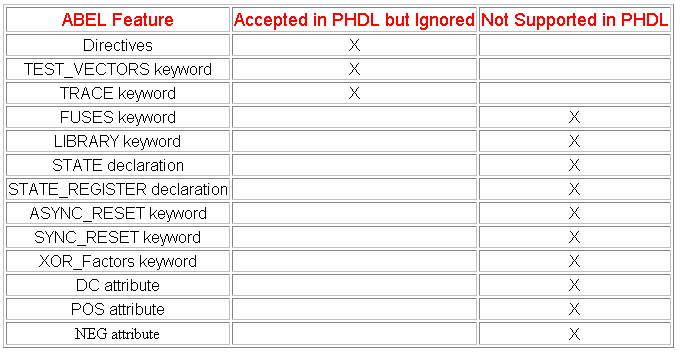 ABEL and PHDL Differences It is important to note that the PHDL compiler will do syntax checking on signals that have register attributes (reg, reg_d, reg_g, reg_jk, reg_sr, and reg_t) to insure that these signals have a clock (.clk) assignment and a consistent input assignment (.d for reg_d, .t for reg_t). If a signal with a register attribute does not have clock assignment or has an inconsistent input assignment statement, an error is generated. This syntax checking with register attributes is not done in ABEL. Also note that CoolRunner CPLDs do not have an inverter between the macrocell and the output pin. Therefore, the INVERT attribute results in the inverter being emulated in the equations for the register input and equations for AR and AP are swapped. However, since CoolRunner 22V10s do have an inverter between the macrocell and the output pin, the INVERT attribute is handled as expected. Here is more information about the INVERT attribute. The INVERT attribute has no meaning for combinatorial signals. For detailed information regarding the differences between ABEL and PHDL, read (Xilinx XAPP312). End of Record #7697 - Last Modified: 01/03/00 11:52 |
| For the latest news, design tips, and patch information on the Xilinx design environment, check out the Technical Tips! |
